CHRONOLOGICAL ACCOUNT
RODRIGO R. DUTERTE Administration (2016 - 2022)
Repackaging in Accordance with New Thrust on the Peace Process
The campaign was repackaged to YES FOR PEACE – BAYANIHAN NG BAYAN para sa Mapayapa, Maunlad at Masaganang Pilipinas pursuant to statement of President Rodrigo R. Duterte, “More than 40 years of armed struggle, and thousands of lives lost is too much to bear.”
Table 13 shows the questions posed vis-à-vis UN Resolution 53/243.
Table 13. YES FOR PEACE Open Referendum Questions Formulated in 2017 vis-a-vis UN Resolution 53/243
| Reformulated Questions | English | UN Resolution 53/243 |
| 1. Sang-ayon po ba kayo na permanente nang itigil ang labanan sa pagitan ng mga sundalo ng gobyerno at ng mga armadong rebolusyonaryo para mailaan na ang bilyon-bilyong pisong pondo na nauubos sa giyera ng mga Filipino laban sa kapwa Filipino para magamit natin ito sa higit na makabuluhang mga serbisyo-publiko tulad ng edukasyon, kalusugan, pabahay, pagsugpo ng kahirapan, pagpapalakas ng kababaihan, pagpapaunlad ng kanayunan, depensang panglabas at iba pa? | Do you agree to the permanent cessation of hostilities between the soldiers of the government and armed revolutionaries so that the billions of pesos spent in the war of Filipinos against fellow Filipinos can be used for more sensible public services such as education, health, housing, eradication of poverty, women empowerment, community development, external defense, etc.? | “Recognizing that peace not only is the absence of conflict, but also requires a positive, dynamic participatory process where dialogue is encouraged and conflicts are solved in a spirit of mutual understanding and cooperation.” Article 3, g. “Promoting sustainable economic and social development.” |
| 2. Sang-ayon po ba kayo na dito na sa Pilipinas ipagpatuloy ang peace talks imbes na sa ibang bansa at gawing hayagan at partisipatibo ang proseso nito para makalahok ang lahat ng sektor ng Sambayanang Filipino at ang mga mambabatas natin sa pagbalangkas, pagpapa-apruba at pagpapatupad ng mga kasunduan? | Do you agree that peace talks be held here in the Philippines instead of other countries and make the process transparent and participatory to enable all sectors of the Filipino people and our legislators to participate in formulating, approving and implementing agreements? | Article 3 e. Strengthening democratic institutions and ensuring full participation in the development process; |
| 3. Sang-ayon po ba kayo na amyendahan na sa lalong madaling panahon ang mga probisyon ng konstitusyon at mga batas na balakid at hadlang sa pagsasakatuparan ng mga kasunduan at mapagkakasunduan sa pagitan ng gobyerno at ng mga armadong reboluyonaryo? | Do you agree to amend constitutional provisions and laws that hamper and obstruct the implementation of existing agreements and future agreements between the government and armed revolutionary forces as soon as possible? | “Recognizing that peace not only is the absence of conflict, but also requires a positive, dynamic participatory process where dialogue is encouraged and conflicts are solved in a spirit of mutual understanding and cooperation.” |
28 July 2016 – PAPP Secretary Jesus C. Dureza wrote, “We note with appreciation the peace advocacy efforts of this citizen-led initiative that you are pursuing and congratulate your unwavering efforts to support the peace process.”
August 2016 (Undated) - In an undated statement, UP President Danilo L. Concepcion wrote, “Just and sustainable peace serves as a central source of continued development, and around it revolves critical aspects of good governance from efficient delivery of social services, equitable dispense of justice, and effective eradication of social ills like poverty and disease. No nation can move forward without peace, and this peace knows no race, color, religion, or social status.
“On this note, I would like to congratulate Yes for Peace-Bayanihan ng Bayan in its staunch commitment to the proactive involvement and collective participation of the Filipino people in the attainment of a lasting sense of peace across the archipelago.
“UP will likewise remain a committed partner in building on these gains that keep us united despite diversity, strong despite adversity, and resilient despite calamity. These ideals are essential to cultivating a democracy that welcomes all citizens regardless of the language they speak, the food they eat, or the prayers they speak.”
25 November 2016 - The YfP-BB campaign was proposed in response to PRRDs request for support of CESOs / NUCESO to PRRD’s Six Point Peace and Development Program presented by OPAPP during the 15th Career Executive Service (CES) Convention held from November 23 to 25, 2016 at the Villa Caceres Hotel, Magsaysay Avenue, Naga City with this year's theme "Convergence for Change: Inspiring Leadership, Integrity in Innovation, Inclusive Development":
- “Meaningful implementation of the FAB and CAB towards healing in the Bangsamoro;
- “Completion of implementation of remaining commitments under the GPH-MNLF Peace Agreement for a just closure;
- “Accelerated signing and implementation of the accords with communist insurgents;
- “Immediate conclusion of the peace process with the CPLA and the RPMP-RPA-ABB;
- “Peace promoting catch-up socio-economic development in conflict affected areas; and
- “Building a culture of peace and conflict sensitivity.”
Pursuant the Govergence concept of the Career Executive Service Board (CESB), Career Service Officers came up with an extensive Menu of Available Government Services for Peace, Development and Social Transformation that can be used by 40,086 Barangays in the whole country in their respective development and investment planning pursuant to the Bottom-Up Budgeting (BUB) approach to the preparation of agency budget proposals of the Department of Interior and Local Government.
The CESB expressed support and hopes that the YfP-BB campaign will lead to convergence of the Filipino people.
The almost eight hundred (800) participants to the convention with the theme, “Convergence for Change: Inspiring Leadership, Integrity in Innovation, Inclusive Development” enriched the list of available programs and projects listed by the learners of the Integrated Gabay ng Paglilingkod ng Paglilingkod (I-GABAY) XXVI class of the CESB issued were enriched by participants in “A Call for Bayanihan Towards a Peaceful, Progressive and Prosperous Philippines”, to wit:
Department of Education- BRIGADA ESKWELA
- Adopt-A-School Program
- Alternative Learning System (ALS) Expansion Program to Remote Barangays
- Establishment of Indigenous People’s Schools in Convergence Areas for Peace and Development
- Partnership with Department of Social Work and Development (DSWD) to bring Out of School Youth / Adults who are members of 4Ps
- Multi-Dimensional Support for Last Mile Schools (additional classrooms, Teacher Items)
- Establishment of Peace Pacts in Schools
- Gulayan sa Paaralan at Tahanan
- ALS Livelihood and Skills Development
- From Arms to Farms (in MILF Camps)
- Opening of Schools in Hinterlands (From “Battleground to School Ground”)
- Conversion of Elementary Schools to Integrated Schools in Hinterlands
- Abot-Alam Program
- Community Learning Centers
- Values/Peace Education for Kinder to Grade 6
- Values/Peace Integration Across Learning/Subject Areas
- BSP/GSP Program Implementation Youth Formation in Communities
- Moral Recovery Program
- Organization and supervision of community-based multi-purpose livelihood cooperatives
- Registration and regulation of cooperatives
- Training and education
- Provision of technical assistance
- Legal assistance to cooperatives
- Project development assistance to cooperatives
- Accreditation of service providers (external auditors and training providers)
- E-Comprehensive Local Integration Program (CLIP)
- Bottom-up Planning and Budgeting
- National Identification System
- LGU Post Offices / Barangay Postal Stations
- Communal Irrigation Systems
- First, Second and Third Level Water Systems
- Kabit-bisig Laban sa Kahirapan (KALAHI)
- Comprehensive Integrated Delivery of Social Services (CIDSS)
- National Community Driven Development Program (NCDDP)
- Sustainable Livelihood Program
- Pantawid Pamilyang Pilipino Program (4Ps)
- Social Pension (sickly, disabled and frail elderly with no existing pensions)
- Supplementary Feeding Program
- Training and Extension Services
- Agribusiness and Marketing Services
- Social preparation
- Production and livelihood
- Marketing assistance and enterprise development
- Provision of Production Loans
- Agriculture and Fisheries Information Services
- Agricultural Credit and Financing Programs
- Sikat Saka Program (SSP)
- Agro-Industry Modernization Credit and Financing Program
- Agri-Microfinance Program (AMP)
- Cooperative Banks Agri-Lending Program (CBAP)
- Community-based Aquatic Resources Development
- Provision of Fishing Gears and Paraphernalia to Fisherfolk
- Provision of Fish (Tilapia and Milkfish) for Grow-out Farms
- Technical Assistance and Technical-Demo project
- Access to production loans, marketing assistance and post-harvest technologies
- Fish seeding of rivers, lakes and water impoundments
- Community Based Forestry Management Program
- Community Based Bio-friendly Enterprises
- Watershed Development Program
- National Greening Program
- Residential and Agricultural Free Patent
- Spring Development Program (proposal-NWRB)
- Minahan ng Bayan
- Social Development and Management Programs
- Comprehensive Agrarian Reform Program (CARP)
- Land distribution
- Adjudication
- Installation
- Support Service:
- Farm Equipment
- Fertilizer
- Support Service:
- Land Tenure Services
- Agrarian Legal Services
- Technical Advisory Support Services
- Inclusive Partnerships for Agricultural Competitiveness
- Multi-purpose small and medium scale hydro-electric dams
- Electric Cooperatives
- Small and Medium Scale Enterprise Development
- Negosyo Serbisyo sa Barangay
- Shared Service Facility Delivery
- Public Utility Vehicle Modernization Program
- 5K Pantawid Pasada
- MOTOR TAXI
- Community-based Eco-Tourism
- Internal Peace and Security Plan
- Small and Medium Scale Enterprise Development
- Doctors to the Barrios program
- Nurses Deployment program
- Mandatory community immersion of medical and nursing students of State Universities (proposal)
- Immunization Program
- Mental Health Programs
- Tutok Gamutan for Tubercolosis (DOTS)
- Farm to Market roads and bridges
- Potable Water Impounding Systems
- Small and Medium Enterprises Technology Upgrading Program
- Community Empowerment through Science and Technology (CEST)
- Technology Transfer and Commercialization/Innovation System Support
- Technical Consultancy, Packaging and Labelling Services
- Testing and Laboratory Services
- Technology Trappings
- Science & Technology Human Resource Development
- Scholarship programs for Undergraduate Science & Technology Courses
- Research and Development
- Integrated Livelihood Program
- Community-Based Training Programs for Vulnerable Sectors with Value Chain Components
- Institution, Center and Community-Based Skills development, scholarships, learning facilitators (teachers and trainors) development
- Technical and Vocational Education Skills
- Development Programs
- Assessment and Certification
- Fiber Expansion and Rehabilitation
- Livelihood Training
- Basic / Upgraded Weaving
- FFS on Abaca
The foregoing list of existing government programs and projects shows that practically all peace and development needs of all Barangays in the country can be addressed and delivered. It is just a question of widely disseminating the information on What, Who, When, Where and How these can be accessed and incorporating it into Barangay Development Programs pursuant to the Bottom-up Planning and Development Program of the DILG and the DBM.
19 December 2016 - The United Nations General Assembly adopted Resolution 71/189, “Declaration on the Right to Peace.”
It states, among others, “Everyone has the right to enjoy peace such that all human rights are promoted and protected and development is fully realized.
March 2017 - the DepEd NEU National Executive Officers and Board of Trustees requested DepEd Secretary Leonor Magtolis-Briones to issue a DepEd Memorandum for the national implementation of the YfP-BB campaign.
06 April 2017 – Secretary Briones issued DepEd Memorandum No. 066, s. 2017 which states, “The Department of Education (DepEd) has sustained its commitment and active participation in the Yes for Peace, a peace education and advocacy campaign which is adopted and incorporated in the Education for All Program, in all public and private elementary and secondary schools nationwide.”
It cited, “President Rodrigo R. Duterte has adopted the Six Point Peace and Development Agenda that include Peace promoting catch-up socio-economic development in conflict-affected areas, and Building a culture of peace and conflict sensitivity.”
02 June 2017 – CHED Commissioner Ronald L. Adamat, OIC, Office of the Chairperson issued a Memorandum, “… attached is a one-page survey to be disseminated by the HEIs to its students to answer, to further raise the people’s participation in the comprehensive peace process.
“CHEDROs are requested to facilitate distribution of the questionnaires to facilitate distribution of the questionnaires to the HEIs.”
07 July 2017 – Ms. Keliza Farrah Dureza - Uy, Chief of Staff / Head Executive Assistant of OPAPP wrote, “Thank you for sending us a copy of information materials on YES for Peace – Bayanihan.
“We are pleased to note that this can serve as reference for the current peace process as well as future peace constituency-building of OPAPP.”
16 August 2017 – Deputy Chief of Staff for CMO, J-7. Deputy Chief of Staff for CMO MGen Melquiades L. Feliciano issued an AFP Message Form 0J-A3-17-08-05 from CSAFP to Commanders, Unified Commands (Attn: U7s):
“4. ITR TO DIRECT YOUR U7s AND SEVENs (7s) OF YOUR OPCON UNITS (INF BDEs, INF BNs, CMO BNs) TO ENGAGE THEIR COUNTERPART DEPED AND CHED OFFICIALS STATIONED IN THEIR RESPECTIVE AORs BY ENJOINING/URGING THEM TO COMPLY WITH THE DEPED/CHED MEMORANDA.”
“5. FOR UTMOST COMPLIANCE AND WIDEST DISSEMINTATION.”
22 August 2017 - Alliance of Concerned Teachers (ACT-Teachers) Representative France Castro opened the discussion on DepEd Memorandum No. 66, 2017 during the House of Representatives Appropriations Committee Meeting on the DepEd Budget.
On 29 August 2017, Secretary Briones issued DepEd Memorandum No. 142, s. 2017 suspending the implementation of the DepEd Memorandum No. 66, s. 2017 citing unspecified “issues raised by some various stakeholders”.
15 September 2017 – despite the DepEd suspension, Police Director Ronald dela Rosa have responded favorably to the request for assistance to follow-through compliance to DepEd Memorandum No. 066, s. 2017.
20 November 2017 – Atty. Domingo B. Alidon, National President of the DepEd National Employees’ Union (DepEd NEU) wrote a Memorandum for All Schools Division Superintendents.
Despite the suspension of the implementation of the campaign, 1,237,780 responses were generated as compliance to DepEd Memorandum No. 66, 2017.
Table No. 14 shows the summary of the answers to three (3) questions field.
Table No. 14. Summary of Answers to the Three (3) Questions Fielded by DepEd Memorandum No. 66, s. 2017
| Question | YES | % | NO | % |
| 1. Sang-ayon po ba kayo na permanente nang itigil ang labanan sa pagitan ng mga sundalo ng gobyerno at ng mga armadong rebolusyonaryo para mailaan na ang bilyon-bilyong pisong pondo na nauubos sa giyera ng mga Filipino laban sa kapwa Filipino para magamit natin ito sa higit na makabuluhang mga serbisyo–publiko tulad ng edukasyon, kalusugan, pabahay, pagsugpo ng kahirapan, pagpapalakas ng kababaihan, pagpapa-unlad ng kanayunan, depensang panglabas at iba pa? | 1,149,279 | 92.85 | 88,501 | 7.15 |
| 2. Sang-ayon po ba kayo na dito na sa Pilipinas ipagpatuloy ang peace talks imbes na sa ibang bansa at gawing hayagan at partisipatibo ang proseso nito para makalahok ang lahat ng sektor ng Sambayanang Filipino at ang mga mambabatas natin sa pagbalangkas, pagpapa-apruba at pagpapatupad ng mga kasunduan? | 1,072,784 | 86.67 | 164,996 | 13.33 |
| 3. Sang-ayon po ba kayo na amyendahan na sa lalong madaling panahon ang mga probisyon ng konstitusyon at mga batas na balakid at hadlang sa pagsasakatuparan ng mga kasunduan at mapagkakasunduan sa pagitan ng gobyerno at ng mga armadong rebolusyonaryo? | 972,524 | 78.57 | 265,256 | 21.43 |
July 2018, - PRRD wrote in a Message, “Cultural differences, political disputes and other socio-economic challenges are some of the reasons why our country cannot totally move forward. These issues have slowed down our nation’s growth
“I recognize this noble undertaking of Yes for Peace – Bayanihan ng Bayan because it promotes a newfound culture of harmony and cooperation among our communities and across our regions...
“Together, let us show our solidarity in effecting real and lasting change in our society.”
September 2018 – Vice-President Leni Robredo wrote, “In a time marked by widespread division and polarization, leaders all over the country are called upon to take a stand against the growing culture of hate and apathy, and instead return our focus to the weak, the powerless, and the defenseless
“We, in the Office of the Vice President, believe that long term and stability are only possible through collaborations to make peace talks, agreements, and community development initiatives more implementable and efficient. It is my deep hope that through this campaign, you will find ways to spark more active participation in order to give voice to our kababayans who suffer in the margins of society.”
04 December 2018 – PRRD issued Executive Order No. 70, “Institutionalizing the Whole-of-Nation Approach in Attaining Inclusive and Sustainable Peace, Creating a National Task Force to End Local Communist Armed Conflict, and Directing the Adoption of a National Peace Framework”
16 December 2018 – Inasmuch as EO 70 was focused in ending the local communist armed conflicts, questions formulated in 2010 and fielded through DepEd Memorandum No. 277, s. 2011 were evaluated and assessed the vis-à-vis Executive Order No. 70, s. 2018. Table No. 15 shows the results of the evaluation and assessment.
Table No. 15. YES FOR PEACE Open Referendum Questions Formulated in 2010 and Fielded Through DepEd Memorandum No. 277, s. 2011 vis-à-vis Executive Order No. 70, s. 2018
| DepEd Memorandum No. 277, s. 2011 | English | Executive Order No. 70, s. 2018 |
| 1. Dapat po bang itigil na ang mga giyera sa pagitan ng gobyerno at mga rebelde ngayong 2012? | Should the wars between the government and rebels stop this 2012? | “WHEREAS, Article II of the 1987 Constitution provides for the following State principles and policies: i. “The Philippines renounces war as an instrument of national policy.” xxx |
| 2. Dapat po bang isaayos natin sa lalong madaling panahon ang mga nawasak ng mga giyera? | Should we rehabilitate communities destroyed by armed conflicts as soon as possible? | “WHEREAS, one of the objectives of the Philippine Development Plan 2017-2022 is to attain inclusive and sustainable peace through intensified development and other peace-building initiatives in conflict-affected and -vulnerable communities.” |
| 3. Dapat po bang gamutin na ngayon ang mga sugat sa puso ng Sambayanan at pagkasunduin na ngayon ang mga sangkot sa mga giyerang ipinaglalaban daw nila para sa kapakanan natin? | Should the wounds in the heart of the Filipino people be healed and reconcile those involved in the armed conflicts waged supposedly for our benefit now? | “WHEREAS, Executive Order No. 16 (s. 2017) adopted the National Security Policy 2017-2022, which calls for the end of all armed threats in the Philippines and recognizes that internal socio-political stability rests upon healing the rifts that divide the nation by promoting participatory governance, synergy of government development efforts, and enhancing the participation and responsibilities of local government units (LGUs);” |
| 4. Dapat po bang palawakin natin ang hanay ng mga Kabayani para sa Kapayapaan na nag-YES FOR PEACE at palakasin ang partisipasyon ng Sambayanang Filipino sa prosesong pangkapayapaan? | Should we broaden the ranks of heroes for peace who have responded to YES FOR PEACE and strengthen the participation of the Filipino people in the peace process? | “WHEREAS, the Whole-of-Nation approach addresses the root causes of insurgencies, internal disturbances and tensions, and other armed conflicts and threats by prioritizing and harmonizing the delivery of basic services and social development packages by the government, facilitating societal inclusivity, and ensuring active participation of all sectors of the society in pursuit of the country’s peace agenda. |
| 5. Dapat po bang baguhin ang mga umiiral na kalakarang panlipunan, pang-ekonomiya at pampulitikal para matigil na ang mga armadong pagututunggali at kaguluhan sa lipunan? | Should we change the existing social, economic and political systems now to stop the armed conflicts and strife in society? | “WHEREAS, Article II of the 1987 Constitution provides for the following State principles and policies: iii. “The State shall promote a just and dynamic social order that will ensure the prosperity and independence of the nation and free the people from poverty through policies that provide adequate social services, promote full employment, a rising standard of living, and an improved quality of life for all.” |
| 6. Dapat po ba nating buuin ang batayan ng pagkakaisa para sa kapayapaan sa pamamagitan ng konsultasyon at partisipasyon ng Sambayanang Filipino? | Should we lay down the basis of unity for peace through consultations and the participation of the Filipino people? | “Section 5. The National Peace Framework. The Framework shall contain principles, policies, plans and programs that will bring inclusive and sustainable peace, and address the root causes of insurgencies, internal disturbances and tensions as well as other armed conflicts and threats in identified areas. The framework shall be responsive to the needs and sensitive to the realities on the ground. To this end, the Framework shall include a mechanism for localized peace engagements or negotiations and interventions that is nationally orchestrated, directed and supervised, while being locally implemented.” |
| 7. Dapat po bang magkaroon na ng pangkalahatang kasunduang pangkapayapaan sa pagitan ng gobyerno at ng lahat ng rebeldeng grupo at epektibong maisakatuparan ang mga ito sa lalong madaling panahon? | Should there be a comprehensive peace agreement between the government and all rebels and effectively implement these as soon as possible? | WHEREAS, to ensure comprehensive orchestration of related peace efforts and initiatives of national government units and various sectors of civil society, there is a need to formulate a National Peace Framework anchored on the Whole-of-Nation approach, which shall include, among others, a mechanism for local peace engagements or negotiations and interventions that is consistent with constitutional integrity and national sovereignty, responsive to local needs, and sensitive to realities on the ground;” |
| 8. Dapat po bang ipagpatuloy ang mga programa para makabalik sa lipunan ang mga rebelde at nang makapamuhay sila nang matiwasay sa kani-kanilang mga komunidad? | Should the programs to reintegrate rebels into society be continued to allow them to live peaceably in their respective communities? | |
| 9. Dapat po bang protektahan ang mga hindi armado at bawasan ang pinsalang dulot ng mga giyerang para daw sa ating mga komunidad? | Should the unarmed be protected and the damages brought by wars supposedly waged for our communities be minimized? | “Section 1. Institutionalizing the Whole-of-Nation Approach. The Whole-of-Nation approach is hereby institutionalized as a government policy for the attainment of inclusive of inclusive and sustainable peace. Towards this end, the Government shall prioritize the delivery of basic services and social development packages in conflict-affected and -vulnerable communities, facilitate societal inclusivity in the pursuit of the country’s peace agenda.” |
| 10. Kailangan bang bumuo ng kaayusan tungo sa kapayapaan sa pamamagitan ng pagtuturo at pagsusulong ng kapayapaan at ng mga hakbang tungo sa pagtitiwala sa pagitan ng gobyerno at mga rebelde? | Do we need to build the conditions to peace by teaching and advocating for peace and through steps towards the restoration of trust and confidence between the government and rebels? | “WHEREAS… xxx, the 50th ASEAN Foreign Ministers meeting in Manila last 05 August 2017, reaffirmed the importance and effectiveness of the Whole-of-Nation approach as opposed to a purely military option in combating terrorism and violent extremism.” |
Table No. 15 shows that EO No. 70 was, as a matter of fact, responsive to the responses to the questions formulated in cooperation with Bayan Muna and the IBON Foundation.
12 December 2018 – The campaign was presented in the Knowledge Sharing Exercise (Human Rights Series) for officers and personnel of the Office of the President proper in observance of the 2018 National Human Rights Consciousness Week of the 70th anniversary of the Universal Declaration of Human Rights.
22 February 2019 – National Security Adviser and Director General of the National Security Council Hermogenes V. Esperon, Jr. wrote to the Project Organizer, “xxx we strongly seek for your participation in said activities in order to get your agency’s inputs in the draft NP-ELCAC for inclusion in its immediate adoption and submission to the President. Likewise, your valuable insights will greatly aid the NTF-ELCAC to easily harmonize and synchronize the various programs and cluster of agencies with the aim of addressing the gaps and creating an inter-operable environment among different government units.”
March 2019 – The SUCBEM Cluster of the NTF ELCAC recommended the following, “Adapt, refine and facilitate the implementation of YES FOR PEACE - Bayanihan ng Bayan, La Liga Independencia, and Sambayanan as Whole-of-Nation undertakings primarily through the DEPED, CHED, DILG, PCUP, NCIP, PHILPOST, OPAPP, NCMF and other National Government agencies.” (Highlighing supplied)
The agencies involved in the SUCBEM are:
- Department of Social Welfare and Development (DSWD)
- Department of Agriculture (DA)
- Department of Agrarian Reform (DAR)
- Bureau of Fisheries and Aquatic Resources (BFAR)
- Department of Environment and Natural Resources (DENR)
- Department of Science and Technology (DOST)
- Department of Interior and Local Government (DILG)
- Department of Information and Communication Technology (DICT)
- Commission on Higher Education (CHED)
- National Youth Commission (NYC)
- Philippine Commission on the Urban Poor (PCUP)
- National Housing Authority (NHA)
- Philippine Commission on Women (PCW)
- Office of the Presidential Adviser on the Peace Process (OPAPP)
- National Commission for Indigenous Peoples (NCIP)
- Presidential Communications Operations Office (PCOO)
- Armed Forces of the Philippines (AFP)
- Philippine National Police (PNP)
- Yes for Peace
The proposed Implementation Plan of Yes for Peace consisted of twenty-six (26) pages (pages 224 to 250) of the National Plan to End the Local Communist Armed Conflict (2019 - 2022).
April 2019 – the national plan was submitted by Secretary Esperon and approved by President Duterte.
In his MESSAGE on the National Plan, President Duterte stated, “We will develop and maintain our civilian bureaucracy and security forces that are capable of simultaneously engaging and supporting multiple areas of operation. Together with the support that comes primarily from the population, we will combine our skills and capabilities to pressure the communists and other terrorist groups, and render them ineffective that their only choice will be to go back to the mainstream society…
“Victory is our goal. To facilitate the realization of our collective aspirations for our beloved country, we must implement our plans on the ground with the whole-of-nation approach, guided by the principles of good governance.” (underscoring ours)
However, the plan was classified as SECRET.
30 May 2019 – Based on inputs gathered from members of the SUCBEM Cluster of the NTF-ELCAC, the questions for the proposed “open referendum” component were once again reformulated and were tested among members of the Career Executive Service who attended the First CES (Career Executive Service) Public Leaders’ Summit with the theme, “Are You Game For CHANGE? Innovation, Inclusion, Inspiration” organized by the Career Executive Service Board from May 29-30, 2019 in Cebu City.
The results are shown in Table No. 16.
Table No. 16. Summary of Answers to Three (3) Questions Fielded During the First CES (Career Executive Service) Public Leaders’ Summit
| QUESTION | YES | NO |
| 1. Sang-ayon po ba tayo na kailangan nating Kilalanin ang Karapatan sa Kapayapaan (Right to Peace) ng Sambayanang Filipino; tutulan ang paggamit ng armas at karahasan para isulong ninuman ang kanilang paniniwala, adhikain, ideolohiya o relihiyon; at tuldukan na ang mga giyera sa pagitan ng gobyerno at mga armadong grupo? | 100.00% | 0.00% |
| 2. Sang-ayon po ba kayo na sariling wika natin ang gamitin at dito sa PIlipinas ituloy ang mga bukas, hayag, inklusibo at partisipatibong Usapang Pangkapayapaan (Peace Talks) -- pambansa man o lokal -- at nang matugunan na ang mga pangangailangan ayon mismo sa mga komunidad at batayang sektor ng lipunan? | 97.83% | 2.17% |
| 3. Sang-ayon po ba kayo na itugma ang umiiral na mga batas sa mga kasunduan tungo sa Kapayapaan, Kaunlaran at Katatagan na hayagang mapagkakaisahan ng gobyerno; ng mga kinatawan ng gobyerno; ng mga armadong grupo; at ng Sambayanang Filipino? | 100.00% | 0.00% |
The results were overwhelmingly encouraging and thus proposed as the set of questions to be fielded as part of the Implementation Plan of Yes for Peace - Bayanihan ng Bayan in the National Plan of the NTF ELCAC.
Upon the suggestion of Secretary Esperon, the implementation plan was "refined" independently of the activities of the NTF-ELCAC but within its working parameters. It particularly focused in how to mobilize the Filipino people’s pro-active involvement and collective participation as the essential component of the Whole of Nation approach to ending the local communist armed conflict.
The adopted call for action was, “An inclusive non-violent movement of the Filipino people to establish an era of a just, unifying, sustainable and lasting Peace.”
July to September 2019 – The refined open referendum questions were fielded among participants to the following: DepEd NEU Luzon Cluster Assembly (July 23 to 25, 2019); DepEd NEU Visayas Cluster Assembly (August 28 to 29, 2019); DepEd NEU Mindanao Cluster Assembly;
The results are summarized in Table No. 17.
Table No. 17. Summary of Answers to Three (3) Questions Fielded During the 2019 DepEd NEU Luzon Cluster Assembles
| QUESTIONS | YES | % | NO | % |
| 1. Sang-ayon po ba tayo na kailangan nating kilalanin at isulong ang mga Karapatan ng Bawat Bata (Rights of the Child) at Karapatan sa Kapayapaan (Right to Peace) ng Sambayanang Filipino alinsunod sa mga deklarasyon ng United Nations General Assembly? | 1,288 | 99.78 | 2 | 0.22 |
| 2. Sang-ayon po ba tayo na dapat na nating tutulan at hadlangan ang terorismo at ang paggamit ng armas o karahasan para isulong ninuman ang kani-kanilang mga paniniwala, adhikain, ideolohiya o relihiyon? | 1,282 | 99.52 | 6 | 0.48 |
| 3. Sang-ayon po ba tayong kailangan ang tulong at pagsang-ayon ng maaapektuhan at makikinabang na mga mamamayan sa pagtukoy, pagpaplano, at pagsasagawa ng mga proyekto at programa tungo sa hinahangad na Kapayapaan, Kaunlaran at Kasaganaan ng bawa’t komunidad? | 1,281 | 99.61 | 5 | 0.39 |
The results were overwhelmingly encouraging. Finally, a set of consensus-building questions that would deliver a clear message to the communists as well as other armed groups that the Filipino people does not support the armed revolution waged in their name had finally been formulated.
Moreover, 100% of the respondents committed:
“Kung kakailanganin, Laging Handa po akong makikipag-BAYANIHAN NG BAYAN – sa abot ng aking kakayanan – sa pagtukoy, pagpaplano, at pagsasagawa ng mga proyekto at programa tulad ng edukasyon, kalusugan, pabahay, pagsugpo ng kahirapan, pagpapaunlad ng kabuhayan, pagpapalawak ng kooperatibismo, pagpapalakas ng kababaihan at iba pang mga makabuluhang serbisyo-publiko dito sa aming komunidad.
“Ipinahihintulot ko rin po na isama ang pangalan ko sa listahan ng mga Filipino na kumikilala at nagsusulong ng mga Karapatan ng mga Bata at ng indibidwal at kolektibong Karapatan sa Kapayapaan ng Sambayanang Filipino para isumite kay President Rodrigo Roa Duterte at ipaalam sa United Nations General Assembly.”
28 August 2019 – the National Board of Trustees adopted DepEd-NEU-NBOT Resolution No. 22, s. 2019 - “Resolution Urging Secretary Leonor Magtolis - Briones to Renew the Participation of the Department of Education to the Yes for Peace - Bayanihan ng Bayan”. Among its premises was, “WHEREAS, the Department of Education’s commitment to the implementation of Yes for Peace - Bayanihan ng Bayan is vital to instill nationalism and patriotism among the youth as well as openly and democratically support the national government’s national objective of ending all armed conflicts.
“Now, therefore, be it resolved as it is hereby resolved that the DepEd-NEU National Board of Trustees (NBOT) requests Secretary Leonor Magtolis – Briones to issue a Department Memorandum to renew participation of the the Department of Education to the YES FOR PEACE – Bayanihan ng Bayan.”
16 September 2019 – DepEd NEU Joint NEO-NBOT Resolution No. 22, s. 2019 was submitted to DepEd Secretary Briones copy furnished President Rodrigo Roa Duterte, Presidential Adviser on Peace, Reconciliation and Unification Secretary Carlito G. Galvez, Jr., and the Project Organizer.
September 2019 - Secretary Esperon advised the representatives of Yes for Peace to organize and register a not for profit non-government organization with the Securities and Exchange Commission to establish a juridical entity to manage and coordinate the campaign.
27 September 2019 – The Securities and Exchange Commission approved the issuance of Company Reg. No. CN201955419 to YES FOR PEACE INC. On September 27, 2019 with the following purposes:
- “To advocate for the permanent cessation of internal armed conflicts to enable the government to shift and allocate billions of pesos wasted in the internal armed conflicts to education, health, housing, eradication of poverty, cooperative development, empowerment of women and other public services.
- “To encourage people to document and stand by their stand to reject the use of arms and violence in the pursuit of anyone’s beliefs, ideology and religion.
- “To push for participative and inclusive peace talks (national and/or local) here in the Philippines instead of abroad to enable all sectors, as well as legislators, to participate in crafting, approving and implementing peace agreements.
- “To initiate activities leading to the declaration of Schools, Barangays, Municipalities, Cities, Provinces, Regions and eventually, the Philippines as Yes for Peace Zones.”
The term of the corporation is fifty (50) years.
February 2020 – While the results were encouraging, the Covid-19 pandemic hit the country in February 2020. Face to face classes were suspended. Thus, the implementation of the YfP-BB campaign through public and private elementary and high schools was no longer doable.
Alongside the development of alternative systems, the open referendum tool was further refined to raise public awareness on Indigenous People’s Rights.
The adopted call for action was, “An initiative to verifiably document a national consensus against terrorism and mobilize the Filipino people’s pro-active involvement and collective participation for the Whole of Nation approach to establish an era of a just, unifying, sustainable and lasting Peace, Progress and Prosperity through Good Governance.”
10 December 2020 – The new set of questions was launched on in celebration of the International Human Rights Day at the University of the Philippines in Diliman.
The questionnaires were fielded among units of the Philippine Army, Philippine Navy and Philippine Air Force through a Directive issued by the Department of National Defense as well as personnel of the National Security Council responded to the open referendum
The responses are summarized in Table No. 18:
Table No. 18. Summary of Answers to Three (3) Questions Fielded Among Units of the Philippine Army, Philippine Navy and Philippine Air Force in 2020
| QUESTION | YES | NO |
| 1. Kailangan bang alamin, itaguyod at isabuhay ang mga Karapatang Pantao (Human Rights); ang mga at ang Karapatan sa Kapayapaan (Right to Peace) alinsunod sa mga deklarasyon ng United Nations’ General Assembly at ang mga Karapatan ng Katutubo (Indigenous People’s Rights) ayon sa RA No. 8371 ng Republika ng Pilipinas? | 100% | 0% |
| 2. Kailangan bang tutulan, hadlangan at labanan ang pagsusulong at paggamit ng armas, karahasan o terorismo para isulong at ipagpilitan ninuman ang mga paniniwala, adhikain, ideolohiya o relihiyon? | 100% | 0% |
| 3. Kailangan ba ang pagsang-ayon, pakikipagtulungan at partisipasyon ng mga maaapektuhan at makikinabang na mga mamamayan sa pagtukoy, pagpaplano, at pagsasagawa ng mga proyekto at programa tungo sa hinahangad na Kapayapaan, Kaunlaran at Kasaganaan ng bawa’t komunidad? | 100% | 0% |
Just like the previous set of questions pre-tested among officers and members of the DepEd NEU, this can very well be used to establish UNITY among the people by documenting a national consensus.
The implementation of the campaign was held at bay because of the Covid-19 pandemic.
01 April 2022 - a copy of the National Plan to End the Local Communist Armed Conflict submitted to and approved by President Duterte in 2019 was provided to the campaign organizer by the NTF-ELCAC by e-mail.
The Sectoral Unification, Capability-Building, Empowerment & Mobilization Implementation Plan starts from page 201 to 312 of the “SECRET” document. Its THREAT SITUATION states, “there is an overarching and urgent need to build, develop, nurture and institutionalize a sustained citizens’ movement for peace building and community development that will include all sectors in implementing an accountability system to attain and sustain good governance at all levels. Thus, there is a widespread need to raise the level of sectoral awareness and consciousness efforts to develop a national culture of peace to prevent any sector from being, time and again, infiltrated by the CTGs and left out with development.”
Yes for Peace is listed as one of the Agencies Involved in the Cluster in page 202. Notably, it is the only non-government / private organization.
The Tasks of Agencies within the Cluster are stated in page 218, "All member agencies of the cluster – National Commission on Indigenous Peoples (NCIP); Office of the Presidential Adviser on the Peace Process (OPAPP); Peace Presidential Consultant on the Urban Poor (PCUP); Department of Education; Philippine Council for Women (PCW); National Youth Commission (NYC); Department of Agrarian Reform (DAR); Bureau of Fisheries and Aquatic Resources (BFAR); Yes for Peace – Bayanihan ng Bayan; Philippine National Police (PNP); Armed Forces of the Philippines (AFP) -- shall ensure the conscious integration of the IMPLAN of the sectoral cluster into the agencies’ policy, planning and management."
The Sectoral Tasks of the Youth and Student Sector are stated in page 221:
"7.5 Implementation of the education and advocacy phase of YES FOR PEACE – Bayanihan ng Bayan through private and public elementary and high schools as well as colleges and universities."
The cluster further recommended the following, “Adapt, refine, and facilitate the implementation of YES FOR PEACE - Bayanihan ng Bayan, La Liga Independencia, and Sambayanan as Whole-of-Nation undertakings primarily through the DEPED, CHED, DILG, PCUP, NCIP, PHILPOST, OPAPP, NCMF and other National Government Agencies’.”
The IMPLEMENTATION PLAN of YES FOR PEACE is presented from page 224 to page 250 (26 pages of the 312-page document).
As discussed earlier, it was reviewed and refined, upon the suggestion of Secretary Esperon, to optimize its impact through the most cost effective and resource efficient action plan to arouse, organize and mobilize direct people participation in the Whole-of-Nation approach to end the local communist armed conflict.
The renewal of the participation of DepEd in the campaign was held in abeyance due to anonymous allegations that the campaign was being used for unallowed fund raising activities.
The primary concern was how to arouse, mobilize and organize the pro-active involvement and collective participation of the people in the process of ending not only the armed conflicts of the government with the local communists but also those with other self-proclaimed armed revolutionary groups.
Basically, the refinement of the campaign revolved upon the involvement of the whole government and the people to attain an era of a just, inclusive, sustainable and lasting peace. According to the implementation plan, each government agency shall contribute in accordance with its functions to ensure the most cost-effective and resource efficient means of holistically addressing the identified needs of the people as the means to bring about good governance.
Moreover, the campaign’s people-centered Road Map to Unity and its Implementation Plan with five (5) thematic areas – Arouse, Organize, Mobilize, Govergence and Charter Change – was refined in line with the United Nations’ Sustainable Development Goal No. 16 – Peace, Justice and Strong Institutions which states, “Promote peaceful and inclusive societies for sustainable development, provide access and justice for all and build effective, accountable and inclusive institutions at all levels.”
The Whole-of-Nation / Whole-of-Society approach of YES FOR PEACE – Bayanihan ng Bayan shall include five (5) thematic areas:
- AROUSE – Establish a national consensus by conducting a national open referendum and awareness sharing dialogues, among Filipinos, 10 years and older, and mobilize all sectors to actively counter violent extremism as well as assert the right to peace.
- ORGANIZE – Enjoin the people-centric upward declaration of YES FOR PEACE Zones from the Schools/ Barangays; to Cities and Municipalities; to Provinces; to the Regions; and finally, the whole country.
- MOBILIZE - Engage the people’s pro-active involvement and collective participation in identifying, planning budgeting and implementing community-based peace and development programs. Open-access to a Menu of Services of existing government projects and programs to address identified needs shall be provided.
- GOVERGENCE – Good governance through the convergent delivery of community peace and development programs and projects identified, planned, budgeted and implemented by the communities.
- CHARTER CHANGE – Revision of constitutional provisions that have impeded national unity, peace, progress and prosperity.
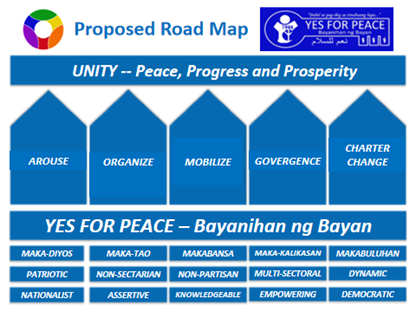
The YES FOR PEACE – Bayanihan ng Bayan ROAD MAP is anchored on the CORE value of Discipline and each phase espouses the following values:

The revised implementation plan and proposed Road Map was submitted for the information and appreciation of PRRD.
16 June 2022 – PRRD wrote, “May warmest greetings to the men and women of the Yes for Peace, Incorporated as you pursue the Yes for Peace – Bayanihan ng Bayan Campaign.
“Since the start of this administration, we have been firm in our desire and mandate to end internal armed conflicts. Our relevant agencies and other key stakeholders have worked collectively to build on the peace that we have achieved over the past decades.
“I thus recognize and laud the significant impact the Yes for Peace Campaign has made since its creation. Your efforts to engage our people in our pursuit of peace truly need the continued participation, organization, and mobilization of individuals and groups alike, for us to realize the freedom that that we all strive for.
“As we transition into a new leadership, I call upon the Filipino people to take proactive involvement in our response to national concerns, and endeavor towards the much-needed unity of our beloved Philippines. May we all continue to work harmoniously towards a more just and free society, especially for future generations.”
1,237,780 responses to the campaign were generated during the administration of PRRD. Cumulatively, 15,597,959 Filipinos have thus far responded to the campaign by the end of the term of PRRD
Who and What Do We Need?